

ALPLA Sustainability Award
Sustainability projects in the spotlight
At ALPLA, sustainability stands for responsible behaviour in three areas: People and society, ecology and environmental impact, and economy and technology. The ALPLA Sustainability Award was created for the first time in 2021 to bring the numerous activities from the entire spectrum, in which employees around the world put their heart and soul, into the spotlight. It doesn't matter whether the projects promote recycling and waste reduction, make internal processes more efficient or protect local ecosystems. Social projects from the neighbourhood of ALPLA locations were also welcome.
"Many ALPLA employees are involved in sustainability projects, proving that each and every one of us can contribute to environmental and climate protection and have a positive impact on society. We wanted to bring this commitment to the fore and recognise it with the award."
Initiator Linda Staib, Senior Sustainability Manager
Winning projects 2025
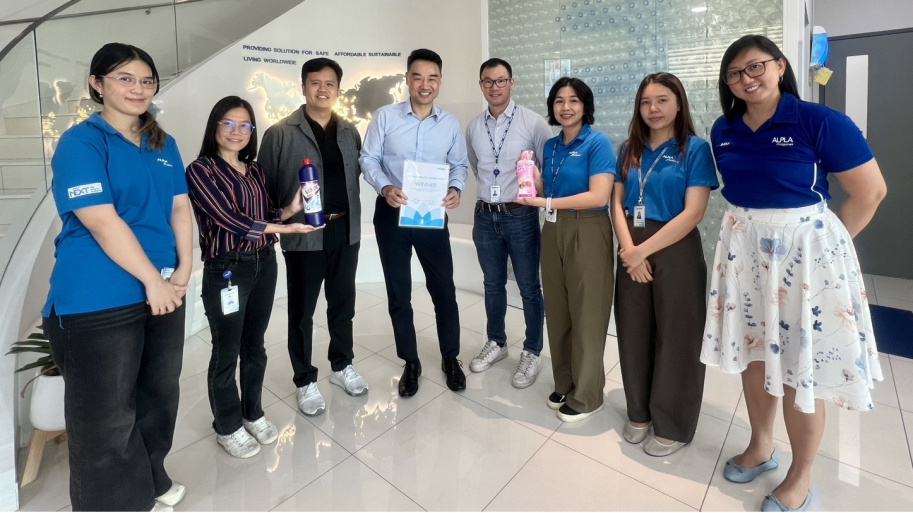
1st place: Closed Loop Recycling, Thailand
The first-placed project impressively demonstrates how the circular economy works in practice. Together with ENVICCO and local customers, ALPLA has established a completely closed recycling loop for HDPE bottles. Collected bottles are sorted on the customer side, processed into high-quality recyclate at ENVICCO and then moulded by ALPLA into new bottles that are reintroduced to the market. The project combines material circularity, CO₂ reduction and security of supply while strengthening long-term customer partnerships.

2nd place: "Fish Buddy" - environmental education and community engagement, South Africa
With the "PET Fish Buddy" project, ALPLArecycling is focussing on environmental education and community engagement in South Africa. Large, fish-shaped collection containers at schools serve as collection points for PET bottles and make recycling tangible for children and families. The project not only increases the amount of PET collected for the ALPLA recycling plant in Ballito, but also actively contributes to reducing littering. At the same time, it promotes awareness of the circular economy far beyond schools.

3rd place: Ultra-light 600 ml CSD bottle, Mexico
The third-placed project stands for sustainable and long-term product development. The team in Mexico developed an ultra-light 600 ml CSD bottle weighing just 15.3 grams for the customer Coca-Cola FEMSA. This corresponds to a reduction of almost 50% over the last 25 years. This was achieved through intelligent design and minimal mould adaptations without compromising on performance or recyclability. The impressive result brings significant material and CO₂ savings as well as a scalable solution for other product portfolios.
Winning projects 2024
The winning project 2024 impresses with the targeted optimisation of the existing wave bottle: a clever redesign has reduced the weight of the bottle and made the logistics more efficient. The weight was reduced by 4g (250ml) and 6g (500ml), resulting in a CO2 reduction of 43% and 35% per bottle respectively.2 per year. This also leads to enormous cost savings.
This social project specifically supports disadvantaged children at the "Hope House" orphanage in Harrismith, South Africa, making a valuable contribution to the education and healthcare of the neediest children. Specifically, the school attendance of four local children is being financed. In addition, the costs of weekly visits to a doctor's surgery are covered to ensure medical care for all 22 children at Hope House.
This project shows how a comprehensive waste analysis and the introduction of sustainable solutions can lead to great progress. With the aim of reducing landfill waste in the USA, disposable towels and oil-absorbent pads were replaced with reusable alternatives. Following a successful pilot project in McDonough, seven other sites followed suit. As a result, six per cent less waste ends up in landfill. In addition to avoiding 65 tonnes of CO2, costs have also been reduced by 18 percent.
Winning projects 2022
Unknown causes of water loss in the cooling circuits of the injection moulds had previously led to increased costs and sometimes even to downtime at ALPLA North America. Digital pulse flow water meters on the pipes were used to detect losses caused by mould growth, leaks and tank overflows. Since then, specially programmed alarms have also warned of excessive water consumption. As a result of these measures, consumption at 16 of the 22 monitored facilities has been significantly reduced by a total of 970 cubic metres of water. Not using chemicals to treat this volume has a positive impact on the environment and reduces costs.
At the beginning of 2021, the team at the Indian ALPLA plant in Silvassa in the Union Territory of Dadra welcomed 27 young female engineers and university graduates. A further eleven female employees followed over the course of the year. Another 13 women were recruited at other plants across the country. ALPLA also supports the women with accommodation, a safe working environment and transport options, thereby increasing the proportion of women in industrial professions in India.
In Dubai, a team of ALPLA employees initiated a project to close air leaks. Systematic measurements are carried out monthly while machines are running to identify any leaks. This constantly ensures that infrastructure, machines and pipes are free of leaks without having to accept downtimes. The installed device also measures the effects of a leak and the potential losses until the fault is rectified.
Winning projects 2021
At the Bridgwater plant, non-recyclable waste was reduced from 497 kg per month in 2016 to an average of just 95 kg in 2021. This was achieved through an awareness of moral responsibility, great commitment and process changes in close cooperation with the customer. Among other things, the following points were implemented:
Awareness-raising for all employees
Clean floors policy
Two-bin system for waste
Black bin sorting: pre-check by the materials technician before disposal to ensure that as much as possible is recycled
Under the motto "Green to Green", ALPLA initiated the use of green bottles made from 100 per cent rPET instead of conventional bottles made from 100 per cent virgin PET and glass at the Slovenian mineral water company Donat. The decision to stop using newly produced PET bottles and reusable glass packaging has led to a reduction in CO2e emissions of up to 90 per cent.
The green PET bottles commonly used on the Slovenian market are collected in Slovenia, recycled in Wöllersdorf and then returned to the shelves as new rPET bottles.
In this project, customer expectations were exceeded with a great deal of commitment. The pearl bottle, which is very well known in Germany, was redeveloped as a returnable PET bottle. A proportion of 10 per cent rPET was required and the bottle had to be refillable 15 times. In the end, the proportion of rPET was 30 per cent and work is continuing on a closed loop. Production of the bottles in Exter has been running since March 2021 and the aim is to supply 25 million bottles per year. The benefits of the project are obvious: a lower CO2 footprint thanks to the higher proportion of rPET, renewable energy and up to 15 cycles.
In Brazil, ALPLA employees organised various projects to support social initiatives and charitable institutions in the fields of sport and education. Selected projects include:
Support for children's homes
Covers for homeless shelters
Food donations for employees in production during Corona
Christmas gifts for orphanages and schools
Winter clothing campaigns for employees
Welcome gifts for newborns at all ALPLA plants in Brazil